Your poetry collection, Rise and Float, came out in 2022. What was the most surprising part of bringing this collection to life? Did publishing during the pandemic present any unique challenges?
When you publish a book, I think you’re so deep in the process of figuring out how to support it and how to maximize its life, and frankly so anxious about how it will “land” with readers, that at times it’s easy to forget a book of poems is one hand reaching out to another, one mind connecting with another—that the connection is the whole point. Once the fog of expectations and worry lifted and the book found its way to people, I was most surprised by the number of readers who reached out to me to say the book mattered, that it moved them, and that I had articulated experiences with mental illness and grief in ways that gave voice and dignity to their own stories and experiences. I can’t think of a greater gift to give a poet than to let them know such a thing. My goal is always to write things that move people, so to know that it did is the type of fuel a maker needs to keep the fire lit.
I was lucky that, while Rise and Float was released in 2022, with the country still in the throes of the pandemic, vaccination helped mitigate the impact on events. There was a relative lull in cases, and so I was cosmically gifted with a small window to go out in the world and celebrate the book in real-time, with real people in a room, for which I am still grateful and which still strikes me as a small miracle at all, let alone during a global health event.
What first drew you to poetry? Was there a particular teacher or writer who inspired you, or a particular poem that sparked your imagination early on?
In all honesty, I found that poetic seed, which eventually sprouted my life as a poet, in music. I’d grown up around music, singing and listening to it nearly all the time. My one grandfather was a jazz aficionado, and he used to have a little group of friends over all the time to listen to records and unpack what was happening and to savor the sounds and argue and celebrate. He also had a lovely tenor and taught me to sing. So all of that was in my DNA. Eventually, I taught myself guitar as a teenager, formed a little garage band, as one does, and began writing songs. My brother learned piano by ear and we’d also play together and were both drawn to songs in which lyrics seemed the point. Even now I can remember the desire and the drive of that time derived more from the writing of lyrics than the making of music itself, though of course as with poetry those two things are inherently interrelated in their own way. But the musicality of language itself, and the sudden urge to speak, to say things, drove me to the page for the first time. I wanted to be Dylan and Springsteen, to write into the space of both telling stories and witnessing the world, as both of those songwriters had and still do. At a certain point in college, this same urge found a distillation in poems, with W.S. Merwin being an early influence.
Your Poetry Mentorship sells out almost every season. What happens in that one-on-one space that you think makes such a difference for writers? Is there a particular insight about craft or process that you find yourself returning to?
As with any instructional relationship, much of the mentorship’s success lies in what poets bring to the table. I believe that is the truth: the instruction of poetry is neither static nor a one-way street, and I think what makes the mentorship unique is my insistence on it being rooted in a conversation around poems, around the making of poems, where not knowing everything is the starting point and the opportunity, instead of a source of insecurity or embarrassment. We think out loud together. We address not only the making of poems and how they are built, as well as anxieties and questions all makers feel and ask in the pursuit, but also devising a practice dedicated to play, to exploration, and to learning by doing and reading. Of course, all of that is poetry instruction in a nutshell. The mentorship merely offers a more intimate version of what is ideally already happening in other workshops or settings, with more time and focus possible in a one-on-one dynamic. I say to my students that “I try always to be a student.” Whatever I’ve learned, whatever wisdom I might have, at one time I did not, and likely within months that wisdom or whatever you might call it is dwarfed by something new, something I didn’t even know I didn’t know. Which is beautiful, isn’t it?
What is your favorite thing about teaching at The Writing Salon?
I love most that the students I work with live in the world and are of the world. Which is not to disparage students in traditional academic settings, who are also quite obviously in the world. However, the students of The Salon are often trying to make art while already being deep into their lives and other commitments, carving out time from parenting, jobs, bills, and every commitment you can think of. I am always grateful and in awe of that dedication, which is no easy thing in 2025, where making space for writing feels maybe harder than ever.
What are you excited about as a writer right now? Do you have any new projects you’re working on?
Right now I’m finishing up my second book of poems and, surprisingly, moving into a third new project I’m not really sure of yet, which makes it all the more enticing to me. There are few things I love more as a poet than not knowing what I’m doing, but sensing in that not-knowing something new, something revealing itself.
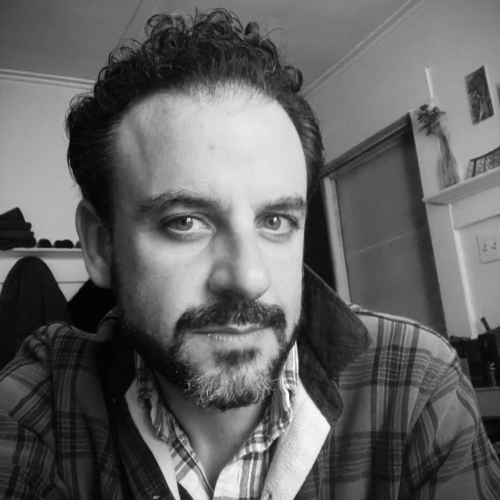
Brian Tierney is the author of Rise and Float (Milkweed Editions, 2022), winner of the Jake Adam York Prize. A former Wallace Stegner Fellow at Stanford University, and a graduate of the Bennington College Writing Seminars, he was awarded the 2018 George Bogin Memorial Award from The Poetry Society of America, and most recently was third-place winner of Narrative Magazine’s 16th Annual Poetry Contest. His poetry and prose have appeared in such journals as POETRY, Paris Review, Kenyon Review, AGNI, New England Review, and others. Raised in Philadelphia, he lives in Oakland, Ca. He also teaches poetry in the Low-Residency MFA Program at Dominican University.
Brian Tierney is the author of Rise and Float (Milkweed Editions, 2022), winner of the Jake Adam York Prize. A former Wallace Stegner Fellow at Stanford University, and a graduate of the Bennington College Writing Seminars, he was awarded the 2018 George Bogin Memorial Award from The Poetry Society of America, and most recently was third-place winner of Narrative Magazine’s 16th Annual Poetry Contest. His poetry and prose have appeared in such journals as POETRY, Paris Review, Kenyon Review, AGNI, New England Review, and others. Raised in Philadelphia, he lives in Oakland, Ca. He also teaches poetry in the Low-Residency MFA Program at Dominican University.